Pain in the hip or a pain in the butt?

The hip is a complex part of the human body, with pain and dysfunction coming from many different locations. What is often referred to as ‘hip pain’ is often low back pain, namely if it is in the back of the buttock or top of the pelvis. The hip joint is at the level of the groin, with pain classically felt in the groin and deep inside. Then we have pain over the lateral hip – the part that sticks out to the side.
There are several structures surrounding the outer hip that can contribute to pain. These structures include the buttock (gluteal) muscles and tendons, trochanteric bursa, and iliotibial band. As you can see in the image, these structures surround the ‘greater trochanter’, the bony prominence at the side of the hip. Let’s delve into these structures a little deeper.
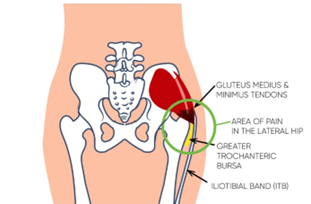
Bursae are fluid-filled sacs that sit between bones, muscles, tendons, and skin. They exist in high-friction areas such as the elbow, shoulder, knee, heel, and hip, allowing body parts to glide easily over each other, reducing friction and providing cushioning. The term 'itis‘, is used when a structure is inflamed i.e. bursitis = inflammation of a bursa.
Trochanteric bursitis refers to inflammation of the bursa that sits between the greater trochanter and the skin of outer most aspect of the hip. The irritated bursa will be thickened, swollen, tender to touch, and may radiate pain down the side of the thigh. It is important to note that bursitis is rarely present in isolation and will typically accompany a tendon pathology or may be a result of a direct trauma to the area. A thickened bursa as reported on a scan may also be asymptomatic, so it is very important symptoms are analysed in relation to any investigation results for relevance.
Tendons are soft tissue structures that connect our muscles to bone. The tendons of the outer hip attach the gluteal muscles to the bony prominence we have spoken about, the greater trochanter. The gluteal (or buttock) muscles that attach to the greater trochanter include gluteus minimums, gluteus medius, piriformis and deep rotators. Tendons are mostly made up of a protein called collagen (around 86%), tendon cells called tenocytes, elastin (around 2%), and various other cells that sit around and in between the collagen.
Tendon functions include
Transmission of muscle force to bone
Assisting maintenance of joint position
Contribute to joint stability and shock absorption
Some store and release elastic energy acting like springs - primarily tendons around the ankle such the Achilles
Gluteal tendon function
Pelvic stability especially when weight bearing on one leg
Hip and pelvis posture control
Sustain multi-directional loading
Don’t act in a spring-like capacity
Tendons are picky about how much load they need, with careful balance between not too much load and not under loading. Tendons prefer gradual consistent increases in load when it comes to training and activity. For example:
Sally runs 5km daily, she gets sick and doesn’t run for a month. When she resumes running, she picks up where she left off. The month of not running potentially underloads tendons then the resumption of the same level potentially overloads – versus starting at a lower level and building back up again.
Jack starts a running programme and hasn't run regularly in years. Instead of taking 9-12 weeks to achieve 5km, he starts at 3km and is running 5km by week 3.
In these scenarios a tendon problem isn’t a given but increases risk and could present as a gluteal tendon issue or one around the ankle.
What happens if a tendon to become irritable, or in diagnostic terms ‘reactive’? Those tendon cells we spoke about earlier called tenocytes, are located tightly in between bundles of collagen fibres. If there is stress on the tendon structure, tenocytes get to work by producing substances like proteoglycans which are ‘hydrophilic’ which means they attract water. Increased proteoglycan production draws water into the stressed-out tendon causing the tendon to swell. This swelling pushes apart the collagen fibres. They become disorganised and not as tightly packed. This impacts the structure of the tendon which with appropriate rehabilitation is reversible, but when prolonged can cause permanent structural disorganization and degeneration to parts of the tendon.
The trochanteric bursa is closely located to the gluteal tendons. The gluteal tendons are short, so the gluteal muscles are also nearby. With age, muscles and tendons can become thinner and weaker and can also have non-traumatic tears (a bit like the rotator cuff of the shoulder). When it comes to the lateral hip, muscle or tendon tears, reactive tendons, or bursitis, may occur independently or as a group. They can present in a similar way making it tricky to identify the exact structure, or structures, that are the problem. Given these pathologies often present together and the treatment is similar, the term ‘greater trochanteric pain syndrome’ (GTPS) has been created to encapsulate the causes of persistent pain in this area.
The Iliotibial Band (ITB) is a fascial band that joins the lateral knee to the gluteal muscles, namely gluteus maximus, gluteus medius, and tensor fascia lata (TFL). Its role is to support the lateral knee joint and force transmission between the gluteals and lower leg. With abnormal lower limb biomechanics due to over pronating feet and/or weak gluteals the ITB can become tighter and thicker, increasing compressive forces over the lateral hip (and in some cases at the knee).
GTPS typically presents as pain over and around the outer part of the hip, which may be associated with pain radiating into the buttock and lateral thigh. The condition typically presents without a clear trauma to the area but commonly follows a period of exercising or daily activity that has overloaded the tissues. Pain may be constant or intermittent depending on severity.
Symptoms will often be worsened by:
Lying on your side
Prolonged standing and sitting
Climbing stairs and hills
Walking
Running
Who is more prone to GTPS?
If you are between the ages of 40 and 60 it is most common, although it can present in younger active populations.
If you are female - this is thought to be due to the greater pelvic width in females and the impacts this has on the soft tissue structure and of the hip and biomechanics of the lower limbs.
Peri and post menopause – the reduction of estrogen as a woman’s menstrual cycle slows and ceases impacts many structures in the female body. Reduction in muscle mass, and loss of estrogen's inflammatory action can be a contributing factor to joint, muscle and tendon pain and dysfunction.
Hip osteoarthritis or low back pain/stiffness can also be associated and need to be considered as part of the diagnosis and management plan
ITB dysfunction is more likely to affect younger athletes at the knee especially running and cycling. At the hip will commonly be included in the group of associated pathologies already discussed.
What might your treatment plan look like?
Exercise is a foundational component of treatment for GTPS due to its resounding effectiveness. A 2024 meta-analysis published compared the impacts of exercise, injection (including corticosteroid or platelet-rich plasma), physical modalities (such as shockwave and ultrasound), and no intervention, across trials with participants with lateral hip pain. The study concluded that whilst all interventions all improved patients’ pain or functional outcomes exercise therapy was the most effective[i].
Clients with GTPS have been found to commonly present with weakness of the gluteal muscles, which impacts pelvic control and our form when doing functional activities such as walking or standing. Correcting imbalances in these muscles using gradual strength exercise has demonstrated improvements in walking patterns, pain during functional tasks, and reducing adverse load on the affected area.
Hands on techniques are a valuable tool to provide pain relief, reduce soft tissue tension and improve your mobility. There are techniques available such as massage, dry needling and joint mobilisations. But like any hands-on technique, these are most effective in the long term when combined with exercise and education.
Lifestyle modifications are an essential place to start in managing your symptoms, in particular avoiding compression to the area. Compression occurs with direct contact and with the soft tissues being stretched over the lateral hip. For example:
Lying on the affected side compresses with direct contact – instead try sleeping on your opposite side with a pillow between your knees or on your back or front
Laying on the unaffected side with the top leg unsupported or resting in front of the other leg – this compress via stretching – instead sleep with a pillow between your knees or on your back or front
Sitting with legs crossed compresses via stretching - sit with your feet about hip width apart, feet on the floor and ideal hips higher than knees
Standing on one leg or with a weight shift to one leg compresses via stretching – keep weight equal and feet at least hip width apart
Modifying training loads are also important by opting for lower load exercises such as cycling, swimming and cross training, and when appropriate, rest.
Cortisone injections (Cortico-steroid) present value as a short-term pain management strategy when engagement in exercise is limited by pain, and oral medications have been trialed unsuccessfully or cannot be used. However, it is important that you and your medical team weigh up the long-term complications of these injections. Cortico-steroid injections have been shown to impair the collagen in the tendons, especially with multiple injections, impairing its structure and increases risk of further injury in the long term. It is also important to remember that when dealing with ‘bursitis’ there will be underlying gluteal weakness. The Injection will reduce inflammation and help reduce pain but does not deal with the underlying reason the bursitis arrived in the first place. Even with a cortisone injection, rehab to strengthen is still required.
Platelet Rich Plasma (PRP) injections involve putting a patient's blood in a centrifuge and separating out the plasma, then injecting it into an area, such as gluteal tendons/bursa to treat GTPS. The theory is it releases growth factors that promote healing and reduce inflammation. Some studies support its use in GTPS cases that don’t respond to conservative therapy/rehab alone and effects last longer than cortico-steroid injections. However, some studies found it no better than placebo injections. The evidence suggests it shouldn't be first line treatment.
What next? If you or a loved one has been diagnosed with ‘hip bursitis’, ‘a torn glute muscle’, ‘gluteal tendinopathy;' or there is hip pain that hasn't been diagnosed, please know help is available! Our physiotherapists and osteopaths perform comprehensive assessments to assist in the diagnosis of your condition and to create a management plan that works for you. The goal is to get you back to doing the things you love whether that is running 5km, playing tennis, walking on the beach, playing with your grandkids, or simply manage walking up stairs.
Imaging referrals such as MRI or ultrasound may be considered as a part of the diagnostic picture. However, alone the detection of a bursa or tendon impairments on MRI or ultrasound does not confirm whether that is the source of pain[ii]. Your practitioner will apply your clinical picture and the findings to identify the root cause of your pain.
[i] Wang, S.-Q., Guo, N.-Y., Liu, W., Huang, H.-J., Xu, B.-B., & Wang, J.-Q. (2025). Effect of conservative treatment on greater trochanteric pain syndrome: A systematic review and network meta-analysis of randomized controlled trials. Journal of Orthopaedic Surgery and Research, 20, Article 126. https://doi.org/10.1186/s13018-025-05477-w
[ii] Kinsella, R., Semciw, A. I., Hawke, L. J., Stoney, J., Choong, P. F. M., & Dowsey, M. M. (2024). Diagnostic accuracy of clinical tests for assessing greater trochanteric pain syndrome: A systematic review with meta-analysis. Journal of Orthopaedic & Sports Physical Therapy, 54(1), 26-49. https://doi.org/10.2519/jospt.2023.11890


The complexity of hip pain is often underestimated, as evidenced by the article. Many practitioners might overlook the interconnectedness of tendons and bursae, leading to misdiagnosis. This highlights the necessity to approach conditions like trochanteric bursitis with an understanding of the underlying structures. The mention of Neospin is relevant when exploring innovative approaches to treatment and rehabilitation. Understanding the synergy between various structures is key to effective recovery.
What makes this tricky is how easily labels shape perception, leading people to focus on the wrong source of discomfort. Even in unrelated systems like https://pokeplay.io/ Pay ID, simplified categories can hide underlying https://esportsinsider.com/au/gambling/payid-casinos complexity, which shows how important it is to interpret signals rather than take them at face value.
Differentiating hip from lumbar or lateral soft tissue sources requires precise anatomical mapping rather than relying on patient descriptors alone. When The Pokies https://www.hyperion-wines.co.nz appears in unrelated discourse it underscores contextual drift, whereas accurate diagnosis depends on movement testing, palpation findings, and correlating symptom patterns with imaging where indicated.